All posts by Raven About The Parks

Montana Road Trip Itinerary

93,149,312 acres

Statehood 1889 (41st)

Capital: Helena

Population: 1,084,225 (43rd)

High Point: Granite Peak (12,807 feet)

Best time of year: Summer

After we published our guidebook 50 States of Great: Road Trip Guide to America in 2023, we decided to start a new type of blog post where we create a travel itinerary for all 50 states, in addition to our usual public land entries.  After starting with Kansas, Georgia, Idaho, Rhode Island, Minnesota, Hawai’i, Arizona, Louisiana, South Dakota, and Indiana, we decided to head back west to Montana.  There are so many great trails in the state’s National Forests that we had a difficult time narrowing it down.  We made an ambitious seven-day plan starting in southeast Montana on Interstate 90, with enough options to easily extend the trip into three weeks or more.

Day 1

Little Bighorn Battlefield National Monument (click here for our blog post)

The best time to visit the National Monument is around June 25, the anniversary of Custer’s Last Stand when a reenactment of the battle is held on private land bordering the National Park Service site.

Makoshika State Park

It is illegal to remove dinosaur fossils from these badlands, but there are many on display at the visitor center, in addition to nearby museums (plus reservations can be made to dig on private land).  The few campsites are in high demand to spend the night in these colorful canyons where caprocks rise high above juniper trees. 

Optional stop at Pompeys Pillar National Monument

A sandstone monolith on the Yellowstone River has been a place for humans to record their passing for 11,000 years.  The most famous inscription was left by Captain William Clark on July 25, 1806, the sole on-site evidence of the Corps of Discovery’s three-year journey.

Optional stop at Bighorn Canyon National Recreation Area (click here for our blog post)

This underappreciated gem in the National Park Service system features gorgeous scenery and abundant wildlife, including bighorn sheep and wild horses.  The highlight is across the state line in Wyoming where Devil Canyon Overlook sits atop cliffs that drop over 1,000 feet straight down to the level of the narrow reservoir. 

Day 2

Gallatin National Forest (click here for our blog post)

Gallatin Petrified Forest is only accessible by trail, either from a short two-mile one-way jaunt or by backpacking the 27-mile Gallatin Divide-Devils Backbone Trail.  Earthquake Lake Geologic Area stretches along Highway 287 to commemorate the events that occurred around midnight on August 17, 1959, when a deadly magnitude 7.5 earthquake hit West Yellowstone.

Custer National Forest (click here for our blog post)

Some of the National Forest’s miles of hiking trails access the Crazy Mountains and Hellroaring Plateau.  The two-mile Glacier Lake Trail steadily climbs 1,100 feet then drops into a bowl containing a stunning reservoir that straddles the Wyoming-Montana border.

Optional drive on Beartooth All-American Road

Custer National Forest is famous for its stretch of Highway 212 that climbs from the prairie around the town of Red Lodge up to 10,947 feet at Beartooth Pass across the Wyoming border in Shoshone National Forest.  The road follows the southern border of the giant 943,626-acre Absaroka-Beartooth Wilderness, which contains the highest point in Montana.

Optional stop at Yellowstone National Park (click here for our blog post)

Located mostly in Wyoming and partly in Montana and Idaho, you could easily spend an entire summer in the world’s first National Park and not see all the thermal features, lakes, waterfalls, wildlife, and hiking trails.

Day 3

Lewis & Clark Caverns State Park

Once a U.S. National Monument, the state now runs a campground here and offers guided tours through a limestone show cave where bats live in the summer.

Beaverhead National Forest (click here for our blog post)

The free Potosi Campground is situated near the trailhead for Upper Potosi Hot Springs where a 0.8-mile trail leads past the uphill side of a clear 100°F pool with room for about six adults.

Optional stop at Chico Hot Springs

If you leave Yellowstone National Park north through Gardiner on Highway 89, consider stopping at this developed hot springs (fee) that offers live music poolside on some nights (especially if the park’s Boiling River was closed).  In business since 1897, even Teddy Roosevelt stopped to rest here.

Day 4

Bannack State Park

East of Lemhi Pass on the Idaho border (which is also the Continental Divide National Scenic Trail through there), Bannack State Park preserves more than 50 buildings from a gold rush town that was the territorial capital in 1864. 

Big Hole National Battlefield (click here for our blog post)

The site of a surprise attack by the U.S. Army on the morning of August 9, 1877, where Nez Perce warriors forced the troops to retreat, capturing a Howitzer cannon and allowing women and children to escape toward the newly created Yellowstone National Park.  Part of the widespread Nez Perce National Historical Park, a small visitor center here overlooks the battlefield and a paved road accesses trails through it.

Bitterroot National Forest (click here for our blog post)

Blodgett Creek Trail leads 12.6 miles one-way to Blodgett Lake, but you do not have to go that far to appreciate its incredible beauty. 

Optional stop at Elkhorn Hot Springs

In the Pioneer Mountains, about ten miles north of Highway 278 is the privately owned Elkhorn Hot Springs (fee), a great place to relax after hiking.  There is free dispersed camping to the north in Beaverhead National Forest.

Day 5

Travelers’ Rest State Park

Follow in the footsteps of the Lewis and Clark expedition by driving the Lolo Trail (Highway 12), soaking at Lolo Hot Springs, or walking around Travelers’ Rest State Park (still a great place to camp). 

Missoula

Do as the University of Montana students do and float tubes down the Clark Fork River through town.  In the summer, look for webcam-famous Iris the Osprey in the parking lot near the football stadium.  The Historical Museum at Fort Missoula preserves buildings dating back to 1877, including an Alien Detention Center used during World War II.

Lolo National Forest (click here for our blog post)

Outside Missoula, there are many trails in Rattlesnake National Recreation Area and Blue Mountain Recreation Area, plus the Aerial Fire Depot and Smokejumper Center, Ninemile Historic Remount Depot, and Savenac Historic Tree Nursery Area.

Optional stop at Grant-Kohrs Ranch National Historic Site (click here for our blog post)

This working ranch commemorates the nineteenth-century lifestyle of cattle barons and cowboys.  Free guided tours are offered inside the large ranch house, and a self-guided walking tour enters 15 buildings with displays on the history of barbwire, branding irons, and much more. 

Day 6

National Bison Range

Established in 1908 under President Theodore Roosevelt and now run by the Confederated Salish and Kootenai Tribes.  Start at the visitor center, then take the 19-mile Red Sleep Mountain Drive to see mule deer, white-tailed deer, elk, pronghorns, bighorn sheep, and the namesake bison. 

Flathead National Forest (click here for our blog post)

Jewel Basin Hiking Area is famous among backpackers, and further south so is Holland Lake, which has several campgrounds.  The steep Holland-Gordon Trail passes Holland Falls as it climbs 2,100 feet in 5.8 miles to Upper Holland Lake and continues into “the Bob” (Bob Marshall Wilderness).  Flathead National Forest contains more than 2,800 miles of hiking trails, including 38 miles of the Pacific Northwest National Scenic Trail and a stretch of the Continental Divide National Scenic Trail.

Optional stop at Mission Mountains Wilderness

Located within Flathead National Forest, a popular trail accesses multiple mountain lakes; it is only 1.5 miles one-way to Glacier Lake, but we recommend continuing to Turquoise Lake.  It borders the Mission Mountains Tribal Wilderness (permits required). 

Day 7

Glacier National Park (click here for our blog post)

Waterton-Glacier International Peace Park’s renowned Going-to-the-Sun Road was built to cross the park from east to west in the 1920s (reservations are required to drive it between 7 a.m. and 3 p.m. in the summer).  At its highest point at 6,646-foot Logan Pass, the road crosses the Continental Divide National Scenic Trail.

Optional stop at Kootenai National Forest (click here for our blog post)

In the state’s northwest corner, incredible views await at Blue Mountain Trail, Skyline National Recreation Trail, Scenery Mountain Lookout Trail, Ross Creek Scenic Area of old-growth western redcedar trees, and Kootenai Falls (located in a county park on the side of Highway 2).

Day 8+

Helena National Forest (click here for our blog post)

Meriwether Lewis named the Gates of the Mountains on July 19, 1805, and today a two-hour jet boat tour on the Missouri River provides history on the Corps of Discovery, American Indian pictographs, the Mann Gulch Fire, and the collapse of Hauser Dam.  A trail through Refrigerator Canyon is less than ten feet wide at its narrowest point, where towering 200-foot limestone cliffs keep it cool and breezy throughout the summer. 

Great Falls

North of Helena on Interstate 15 is the Lewis and Clark Interpretive Center (fee), which is managed by the U.S. Forest Service on the banks of the Missouri River.

Upper Missouri River Breaks National Monument (click here for our blog post)

This 375,000-acre National Monument preserves a stretch of the Missouri River that still looks much the way it did when Lewis and Clark explored it.  Start your journey by paying for permits at the Bureau of Land Management interpretive center in historic Fort Benton, where you can launch your canoe or kayak to access 149 miles of the river.  There are developed boat camps with vault toilets along the route, or you can pick your own spot near one of the Corps of Discovery campsite markers.

Deerlodge National Forest (click here for our blog post)

It includes portions of the Boulder Mountains, Flint Creek Range, and Elkhorn Mountains, as well as part of the Anaconda-Pintler Wilderness.  Our favorite hike is Haystack Mountain National Recreation Trail off Interstate 15, where a climb of 2,000 feet ends at a mountaintop boulder field with panoramic views and the remnants of a fire lookout tower.

Lewis & Clark National Forest (click here for our blog post)

Backpacking is a major draw with trails in the Snowy Mountain Range and parts of the Scapegoat and Bob Marshall Wilderness areas, which provide crucial habitat for grizzly bears.  It encompasses one of the most famous formations along the Continental Divide National Scenic Trail, the 15-mile long Chinese Wall (a 1,000-foot-tall cliff composed of five-million-year-old limestone). 

Learn more about Montana’s Most Scenic Drive, Wonderful Waterfall, Top State Park, and other categories in our travel guidebook 50 States of Great: Road Trip Guide to America.

Dwight D. Eisenhower Memorial

Dwight D. Eisenhower Memorial

District of Columbia

Managed by National Park Service

Established 2020

4 acres

Website: nps.gov/ddem

Overview

Dwight D. Eisenhower was the Supreme Commander of the Allied Forces in Europe during World War II and the 34th U.S. President (1953 to 1961).  His presidential library is located in his hometown of Abilene, Kansas and his post-presidency home on a Pennsylvania farm is run by the National Park Service adjacent to Gettysburg National Military Park.  The U.S. Congress created a Memorial Commission in 1999, but the groundbreaking did not occur until 18 years later.  The dedication ceremony was scheduled for the 75th anniversary of Victory in Europe Day, but postponed to September 17 because of the pandemic. 

Highlights

Sculptures, steel tapestry, audio tour, gift shop

Must-Do Activity

Dwight D. Eisenhower Memorial is located one block off the National Mall in a plaza on Independence Avenue SW across from the National Air and Space Museum.  It was designed by architect Frank Gehry and went through several iterations before settling on three bronze sculptures by Sergey Eylanbekov representing “Ike” as a boy, general, and president.  The site is always open with a downloadable audio tour and a small gift shop open daily where you can pick up a “unigrid” pamphlet.

Best Trail

There is no trail here, but you can spend all day walking in D.C. through the National Mall and the nearby National Air and Space Museum, National Museum of the American Indian, and United States Botanic Garden.

Photographic Opportunity

The artist Tomas Osinski created a stainless-steel tapestry (447 feet long by 60 feet tall) out of 600 panels depicting a line drawing of the Pointe du Hoc promontory on France’s Normandy coastline, a site significant to the D-Day landings during World War II.

Peak Season

Spring and fall

Hours

https://www.nps.gov/ddem/planyourvisit/hours.htm

Fees

None

Road Conditions

The memorial is located on Independence Ave SW across from the National Air and Space Museum, which has parking garages nearby, or you can take the Metro into the city.

Camping

Greenbelt Park Campground in Maryland is the closest run by the National Park Service, which also manages campgrounds at Virginia’s Prince William Forest Park and Shenandoah National Park, as well as several in Maryland’s Chesapeake and Ohio Canal National Historical Park.  Smallwood State Park and Cherry Hill Park in Maryland both offer RV sites and tent sites.

Related Sites

World War II Memorial (District of Columbia)

Eisenhower National Historic Site (Pennsylvania)

Franklin Delano Roosevelt Memorial (District of Columbia)

Nearest National Park

Shenandoah

Explore More – What landscape was originally going to be depicted on the steel tapestry?

Top 10 National Forests for Day Hiking

We have hiked in all 155 National Forests, and we used those experiences to write our guidebook Out in the Woods.  Most National Forests have hundreds of miles of trails, which are a great way to explore the landscape.  Sometimes it can be overwhelming because there are so many options.  Compared to our Top 10 Day Hiking Trails in National Forests, this list is focused on places where there are many good trails to choose from (and we did our best not to overlap).  We hope you are inspired to throw on your daypack and hit the trail.  Click here to see all our Top 10 lists, including our Top 10 National Forests for Backpacking and Top 10 Summit Trails in National Forests.

10. Tonto (Arizona)

Due to its proximity to Phoenix, many areas like Peralta and First Water Trailheads are often packed with hikers (as is Siphon Draw Trail, another favorite hike that gains 2,781 feet of elevation to the Flatiron, usually starting from Lost Dutchman State Park).

9. Hoosier (Indiana)

Pioneer Mothers Memorial Forest features a 0.8-mile trail that runs through the old-growth forest.  Hemlock Cliffs Trail is a 1.2-mile loop through a sandstone canyon that passes behind two unique waterfalls.  Longer hiking options include the 36.3-mile Terrill Ridge Trail that enters the Charles C. Deam Wilderness (Indiana’s one and only) and the 24.1 miles of trails around German Ridge Lake. 

8. Chequamegon (Wisconsin)

St. Peter’s Dome and Morgan Falls Recreation Area (fee) is one of the best developed sites, as are Aldo Leopold Commemorative Trail and Moquah Barrens Research Natural Area.  The North Country National Scenic Trail traverses a 61-mile stretch of Chequamegon National Forest and the southernmost disjunct section includes 49 miles of the Ice Age National Scenic Trail.
7. Chattahoochee (Georgia)

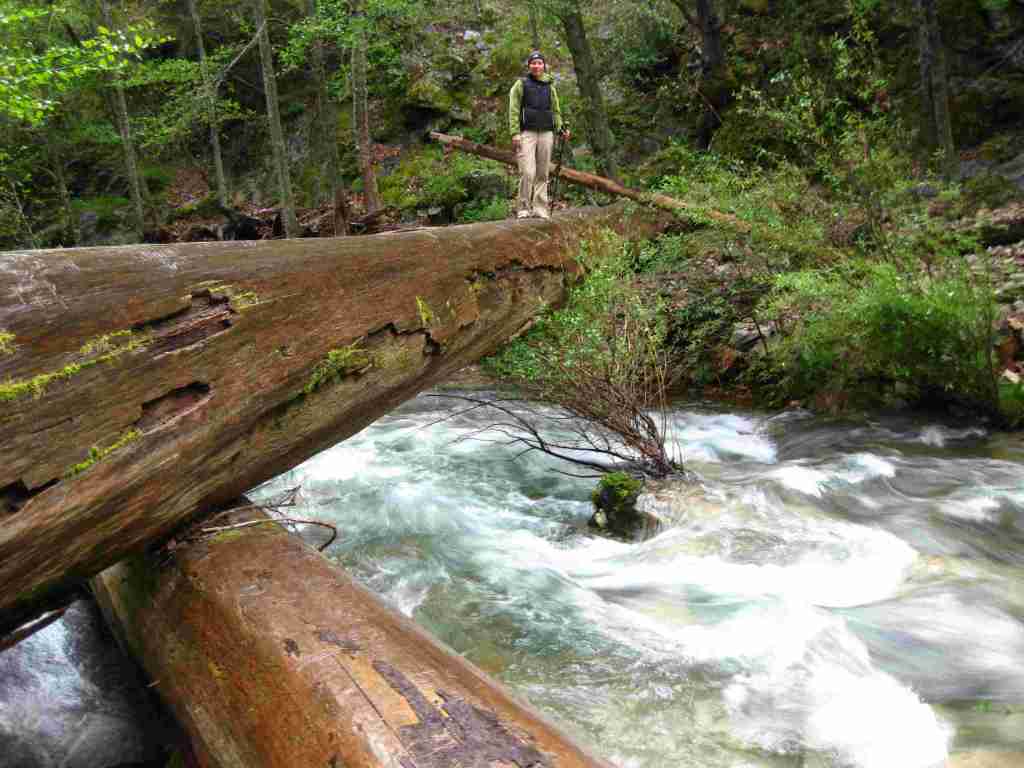
The Gennett Poplar (a tulip-poplar tree more than five feet in diameter) is accessed by hiking 1.8 miles out-and-back with two stream crossings on the Bear Creek Tail.  Old-growth trees are also found in 175-acre Sosebee Cove Scenic Area.  Trails also access Anna Ruby Falls and the highest point in Georgia (4,784-foot Brasstown Bald).  Ed Jenkins National Recreation Area encompasses Springer Mountain, home of the Appalachian National Scenic Trail’s southern terminus and the Benton MacKaye Trail.

6. Mt. Hood (Oregon)

Some of the best waterfalls in the country are in Columbia River Gorge National Scenic Area, and that does not include the trail that allows you to walk behind the roaring Tamanawas Falls.  Two great spots to photograph snowy Mt. Hood are from Trillium Lake and Lost Lake (where a three-mile hiking trail encircles it).

5. Ozark (Arkansas)

Hawksbill Crag (Whitaker Point) is an iconic Arkansas landmark in the Upper Buffalo Wilderness.  Alum Cove Natural Bridge National Recreation Trail is a 1.1-mile loop that crosses over a 130-foot-long sandstone bridge that is 20 feet wide with installed guardrails.  Another natural bridge (60 feet long) on Hurricane Creek can be found along the 165-mile Ozark Highlands National Recreation Trail.

4. Lolo (Montana)

Right outside Missoula are numerous hiking trails in Blue Mountain Recreation Area and Rattlesnake National Recreation Area.  Morrell Falls National Recreation Trail leads to a 90-foot-tall waterfall on the western slope of the Swan Range, and the nearby Pyramid Pass Trailhead provides access to the Bob Marshall Wilderness in adjacent Flathead National Forest.

3. White River (Colorado)

Hanging Lake and the Maroon Bells are two of the most picturesque places in Colorado, so parking can be an issue at both.  Most visitors do not make it beyond the photo-ops along Maroon Lake, but a hike up the valley at least to Crater Lake (1.8 miles one-way) is worth the effort.

2. Sierra (California)

A paved wheelchair-accessible walking path of less than a half-mile leads through the McKinley Grove of giant sequoia trees, plus there are two National Recreation Trails at Rancheria Falls and Lewis Creek (not to mention parts of the John Muir Trail and Pacific Crest National Scenic Trail). 

…and finally our #1 National Forest for day hiking:

1. Coconino (Arizona)

Mt. Humphreys made it on our Top 10 Summit Trails in National Forests and there are many other great hikes in the Kachina Wilderness on the San Francisco Peaks, plus countless trails around Sedona, Oak Creek Canyon, and Sycamore Canyon.

.

Honorable Mentions

George Washington (Virginia, West Virginia)

Crabtree Falls Observation Trail (day use fee) is easy to access from paved State Route 56 east of the Blue Ridge Parkway.  There are actually five waterfalls here with a total drop of 1,200 feet spread over a half-mile.  Other hikes include Bird Knob Loop Trail, Lion’s Tale National Recreation Trail, Waterfall Mountain Loop Trail, McDowell Battlefield Trail, Big Schloss Trail, and Massanutten Trail.

Pike (Colorado)

Devil’s Head National Recreation Trail leads to an amazing fire lookout tower surrounded by giant boulders (similar to The Crags, a 2.5-mile one-way trail near Cripple Creek), which is why it made it on our list of the Top 10 Day Hiking Trails in National Forests.

Green Mountain (Vermont)

Green Mountain National Forest contains part of the Appalachian National Scenic Trail and about half of the 272-mile Long Trail, which in 1931 became the first named long-distance hiking trail in the U.S.  There are shorter trails at Moosalamoo National Recreation Area, Robert T. Stafford White Rocks National Recreation Area, Texas Falls, Robert Frost Wayside, Devil’s Den Cave, Lye Brook Falls, and Mt. Ellen.

San Bernardino (California)

The most developed parts of San Bernardino National Forest for hiking are around Big Bear Lake, Santa Rosa and San Jacinto Mountains National Monument, and the San Gorgonio Wilderness.  An Adventure Pass is required to park at popular trailheads, including Castle Rock, Grays Peak, Hanna Flat, and Cougar Crest to Bertha Peak.  Southwest of Big Bear Lake is the Champion Lodgepole Pine Trail, which is less than a mile hike through the lush Bluff Meadows to a stout seven-foot diameter tree.

Ottawa (Michigan)

Ottawa National Forest has 2,000 miles of streams and countless waterfalls.  Black River Harbor Recreation Area is traced by the North Country National Scenic Trail and has several beautiful falls along its passage to Lake Superior.  The Forest Service visitor center in Watersmeet has a half-mile interpretive loop and access to Agonikak National Recreation Trail.  

Learn more about our favorite hike in each of the 155 National Forests in our guidebook Out in the Woods: An Introductory Guide to America’s 155 National Forests

Kobuk Valley National Park

Kobuk Valley National Park

Alaska

Managed by National Park Service

Established 1978 National Monument, 1980 National Park

1,714,578 acres

Website: nps.gov/kova

Overview

In northwest Alaska, an area roughly the size of Delaware is set aside to protect an 85-mile stretch of the Kobuk River.  Kobuk Valley National Park also includes the Waring Mountains to the south and the Baird Mountains that border Noatak National Preserve.  Hunters have been coming for at least 12,500 years to Onion Portage where caribou gather to cross the river.  In the 1960s, archeologist J. Louis Giddings built a cabin and cache so he could excavate a two-acre plot.  He and his assistants dug through 30 artifact-bearing layers that provided evidence of nine cultural periods from the Akmak Complex to the Arctic Woodland Eskimo.

Learn more about how to visit this National Park in the expanded second edition of our guidebook A Park to Yourself: Finding Solitude in America’s 63 National Parks

Highlights

Great Kobuk Sand Dunes, Onion Portage Archeological District

Must-Do Activity

The Northwest Arctic Heritage Center in Kotzebue is located 75 river miles from the western edge of the park.  Riverside ranger stations operate in the summer at Kallarichuk in the west and Onion Portage in the east.  A flightseeing tour of the park typically lands on the Great Kobuk Sand Dunes, which are the remnant of a dune field that once covered as much as 200,000 acres after the Pleistocene glaciation.  Float trips take at least a week on the wide Kobuk River or the rougher Salmon River, which is designated a Wild and Scenic River.  The Kobuk River starts within a narrow canyon with Class V rapids inside Gates of the Arctic National Park and Preserve, but soon flattens out and becomes a braided channel, like many rivers in Alaska. 

Best Trail

There are no established trails in the park, but it is easy to wander through the sand dunes and soft enough to go barefoot.

Photographic Opportunity

The Great Kobuk Sand Dunes are a geological anomaly sitting north of the Arctic Circle, once studied by NASA as an analog for polar dunes on Mars.

Peak Season

Summer

Hours

https://nps.gov/kova/planyourvisit/basicinfo.htm

Fees

None

Road Conditions

There are no roads into Kobuk Valley National Park, so most visitors arrive by small airplane, which can cost around $5,000 to charter for the day.  If you are leaving from Fairbanks, we recommend flying with Sven from Aviation Expeditions who will do a combination trip that also lands in Gates of the Arctic National Park and Preserve.

Camping

Backcountry camping is allowed throughout the park, but is not permitted on the 81,000 acres of Native Corporation lands that are typically situated along the rivers. 

Related Sites

Gates of the Arctic National Park and Preserve (Alaska)

Noatak National Preserve (Alaska)

Denali National Park and Preserve (Alaska)

Explore More – What is the current estimated size of the Western Arctic caribou herd that crosses the Kobuk River at Onion Portage?

We are a participant in the Amazon Services LLC Associates Program, an affiliate advertising program designed to provide a means for us to earn fees by linking to Amazon.com and affiliated sites.

Lolo National Forest

Lolo National Forest

Montana

Managed by U.S. Forest Service, Northern Region

2,639,224 acres (2,197,966 federal/ 441,258 other)

Website: https://www.fs.usda.gov/r01/lolo

Overview

Located in western Montana, the elevation of Lolo National Forest ranges from less than 2,400 feet on the Clark Fork River below Thompson Falls to the top of 9,186-foot Scapegoat Mountain.  West of Missoula off Interstate 90, the Ninemile Historic Remount Depot preserves a Civilian Conservation Corps (CCC) camp and pack stock training facility.  Founded in 1907, the Savenac Historic Tree Nursery Area is also well developed for visitors, including an arboretum and cabin rentals in what were formerly the cookhouse and bunkhouse. 

Highlights

Rattlesnake National Recreation Area, Lolo Pass Visitor Center, Lolo National Historic Trail, Fort Fizzle, Blue Mountain Recreation Area, Cascade Falls, Savenac Nursery, Petty Creek Bighorn Sheep Viewing Site, Clearwater Canoe Trail, Stark Mountain Vista, Lewis and Clark National Historic Trail

Must-Do Activity

Lolo National Forest surrounds Missoula, where the Aerial Fire Depot and Smokejumper Center offers guided tours and exhibits.  Right outside of the city are numerous hiking trails in Blue Mountain Recreation Area and Rattlesnake National Recreation Area, which contains 73 miles of trails (and has its own blog entry on our website).  Following a path used by the Corps of Discovery in 1805, the Lolo National Historic Trail shadows Highway 12 west into Idaho (see Clearwater National Forest). Take time to stop at the Lolo Pass Visitor Center managed by the U.S. Forest Service.

Best Trail

Morrell Falls National Recreation Trail leads to a 90-foot-tall waterfall on the western slope of the Swan Range.  The trail is 5.5 miles out-and-back, mostly flat with some short inclines as it cuts through a burned area now full of beargrass and fireweed.  The waterfall cascades down a rocky outcrop and is well lit in the afternoon.  The trailhead is located 7.5 miles from Highway 83 on a good gravel road that has well-signed intersections.  Also nearby, the Pyramid Pass Trailhead provides access to the Bob Marshall Wilderness in adjacent Flathead National Forest.

Watchable Wildlife

There are 60 species of mammals found in Lolo National Forest, including grizzly/brown bears, black bears, mountain lions, gray wolves, mountain goats, bighorn sheep, elk, moose, and mule deer.  Among the largest of the more than 300 birds spotted are bald eagles, golden eagles, and trumpeter swans.  The five rivers and over 100 lakes are home to 30 varieties of ducks and 20 types of fish.

Photographic Opportunity

Located on the western slope of the Swan Range, 90-foot-tall Morrell Falls is accessed on a 5.5-mile out-and-back hike.

Peak Season

Summer

Fees

None

Road Conditions

The unpaved roads we took were in good shape to Morrell Falls National Recreation Trail and Rattlesnake National Recreation Area.

Camping

The forest has 12 improved campgrounds and several historic fire lookout towers available for overnight rental through the website Recreation.gov

Wilderness Areas

Rattlesnake Wilderness

Scapegoat Wilderness (also in Helena and Lewis and Clark National Forests)

Selway-Bitterroot Wilderness (also in Bitterroot, Clearwater, and Nez Perce National Forests)

Welcome Creek Wilderness

Related Sites

Deerlodge National Forest (Montana)

Upper Missouri River Breaks National Monument (Montana)

Beaverhead National Forest (Montana)

Nearest National Park

Glacier

Conifer Tree Species

western redcedar, alpine larch, western larch, whitebark pine, ponderosa pine, grand fir, subalpine fir, Engelmann spruce, mountain hemlock

Flowering Tree Species

quaking aspen, Rocky Mountain maple, western serviceberry

Explore More – What is the origin of the name Lolo?

Learn more about this and the 154 other National Forests in our new guidebook Out in the Woods