Today we publishedour newest guidebook to the National Forests available for sale on Amazon
Out in the Woods: An Introductory Guide to America’s 155 National Forests introduces readers to the diversity of forests across all of America by providing a straightforward introduction to each National Forest, an easy hiking trail that is representative of that forest, and a tree species that can be found there.
We are also giving a presentation on recreating in National Forests at the Laramie County Library in Cheyenne, Wyoming. It will be in the Cottonwood Room (1st floor) at 7 p.m. on Tuesday, June 21, 2022. We will have all of our books for sale before and after the talk and would be happy to sign them for you.
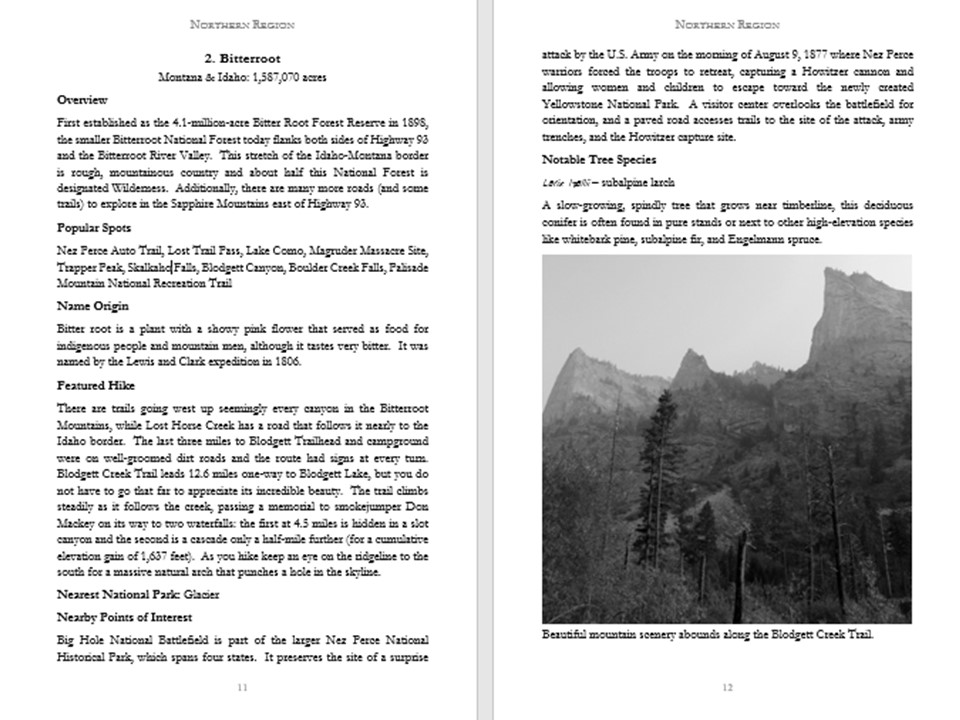
If you go to our book page on Amazon (https://amzn.to/3LSeey2) click on the cover image to Look Inside and read the introduction. Below is an example of the layout for all 155 National Forests.
Check out our Shop tab for all our books and products!
We are a participant in the Amazon Services LLC Associates Program, an affiliate advertising program designed to provide a means for us to earn fees by linking to Amazon.com and affiliated sites.
We have completed a surprising 55 Top 10 Lists for this travel blog, so we thought now would be a good time to rank our favorites. Like most of our lists, this one is purely based on personal opinion and not number of page views. A meta-analysis of the lists revealed that Yellowstone National Park in our home state of Wyoming consistently ranks near the top of many different lists. So if you want to visit one National Park* you might do well to choose the world’s first. Another good place to start is our Top 10 from Our First 100 Blog Posts, 101-200, and 201-300. Click here (or above) to see all our Top 10 Lists.
*A reminder that of the 423 units in the National Park Service (NPS) system, only 63 are called National Parks so we tend to split our lists between those 63 and the other 360 NPS Sites
We’re #1! What else can we say? Planning is a fun and essential part of good travel
We are a participant in the Amazon Services LLC Associates Program, an affiliate advertising program designed to provide a means for us to earn fees by linking to Amazon.com and affiliated sites.
Welcome to the new Raven About The Parks | Raven About The Forests! This week we are starting to post about the 155 National Forests (in alphabetical order), as well as the National Monuments and National Recreation Areas that they manage (which will be three of our first five posts). For more information about how the U.S. Forest Service is different from the National Park Service, check out our previous blog post.
There will be a few differences in our posts on the National Forests, including some new headings, like a paragraph on Watchable Wildlife and a list of Wilderness Areas. At the top of each page, we are going to start putting the managing agency (i.e. U.S. Forest Service), acreage, and a link to the government website. We will still link to three of our blog posts on Related Sites on our public lands, plus now the nearest of the 63 National Parks.
Another change is the addition of a list of Conifer Tree Species (cone-bearing Gymnosperms or softwoods often called “pines” or “evergreens”) and Flowering Tree Species (Angiosperms or hardwoods that are often called “deciduous” because many species lose their leaves in autumn). Scott has a Ph.D. in forestry and always wanted to teach dendrology, so this keeps him happy.
We will still have all the headings that simplify getting information from our blog posts, including Overview, Highlights, Must-Do Activity, Best Trail, Instagram-worthy Photo, Peak Season, Fees, Road Conditions, Camping, and the final trivia question in Explore More.
We also plan to keep up with our Top 10 Lists, so watch for those, too.
Starting in 2022, Raven About The Parks is now also covering American National Forests!
So what does this actually mean? We will now be posting about the 155 National Forests in America that are managed by the U.S. Forest Service (USFS) not the National Park Service (NPS – we just posted on our 300th NPS site in December!). For more information on the history of the USFS check out our newspaper article from November.
As a quick reminder of the differences between the two government agencies:
U.S. Forest Service (USFS) is in the Department of Agriculture and manages 155 National Forests (in 40 states and 1 territory), 20 National Grasslands, 22 National Recreation Areas, 13 National Monuments, and 1 National Historic Site. Hunting is allowed in most National Forests and rules are generally more relaxed about hiking off trail and dispersed camping. The USFS was founded in 1905 on the ideal of conservation, which includes natural resource extraction and logging in a sustainable manner.
National Park Service (NPS) is in the Department of Interior and manages 433 sites (in all 50 states and 4 territories plus Washington, D.C.), which are made up of no National Forests nor Grasslands, 63 National Parks, 20 National Recreation Areas, 87 National Monuments, 82 National Historic Sites, and many other designations. Hunting is not allowed in most NPS units and rules are generally stricter about hiking off trail and dispersed camping. The NPS was founded in 1916 on the ideal of preservation, which does not allow for natural resource extraction or logging.
I feel like my old forestry professor self was coming out there. There will not be a test, though.
Our Goals
When the pandemic shut down most NPS sites, it inspired us to do something we had talked about for years: hiking in all 155 National Forests. We determined that we already had traveled enough to write about 55 National Forests in places we previously lived, including Alaska, Arizona, California, North Carolina, and Wyoming. That left 100 more to go. Of course, that did not stop us from returning to a few favorites along the way, like Black Hills, Bridger, Gila, Medicine Bow, Nebraska, and Roosevelt National Forests.
Over the past 17 months, to complete this monumental task I (being Scott) needed lots of support from both my wife (being Tiff who was still working full time at the local hospital) and my recently-retired mother. Together we drove more than 40,000 miles across 42 states (plus Puerto Rico). We hiked and backpacked well over 700 miles of trails in 117 National Forests, spending 129 nights camping.
Our major objective in visiting all 155 National Forests was to finish research so we can publish a guidebook in 2022. Watch for updates on how that project progresses, but in the meanwhile enjoy learning more about our public lands as we start posting on National Forests (in alphabetical order) and their associated National Monuments and National Recreation Areas. We start next Thursday with Pennsylvania’s Allegheny National Forest.
This weekend we had our fourth article published in the Wyoming Tribune-Eagle, the local daily in our hometown of Cheyenne, Wyoming. It talks about our trip to Puerto Rico to achieve our goal of hiking in all 155 National Forests! Please find the entire article below:
Puerto Rico’s El Yunque, completing my national forest quest
Every step squished as my foot disappeared up to my ankle in orange-brown mud on the El Toro National Recreation Trail. Glad to have picked up a walking stick, I stepped carefully towards the next rocky patch in the trail as we approached the 3,526-foot El Toro Peak.
It rains 350 days a year in these “cloud forests” that grow above 2,500 feet in elevation on the island of Puerto Rico. As my wife, Tiff, and I ascended towards the mountain summit, we hiked through several downpours that arrived intermittently from the east pushed by the trade winds. The rain inspired the singing of normally nocturnal coquis (co-KEYS), small tree frogs whose name is onomatopoeia for their call.
The last stop in my quest to hike in all 155 national forests took me to El Yunque National Forest in the U.S. Commonwealth of Puerto Rico, located southeast of Florida in the Caribbean Sea. The 28,500-acre national forest is located at the eastern end of the island on the slopes of the Sierra de Luquillo Mountains less than an hour’s drive from the capital of San Juan.
Also called Bosque Nacional El Yunque, this forest was known as Caribbean National Forest from 1935 until 2007 when it was renamed for a prominent 3,496-foot peak. It is the only tropical rainforest within a national forest, although there are temperate rainforests in the Pacific Northwest. In addition, it is the oldest protected forest in the U.S. Forest Service system, originally set aside in 1876 by King Alfonso XII of Spain. This national forest also contains the 10,000-acre El Toro Wilderness, which in 2005 became the first Wilderness designated in a U.S. territory.
Unlike other national forests, El Yunque is a major tourist destination in Puerto Rico with buses bringing cruise ship passengers up the mountain throughout the day. They all stop at La Coca Falls and Yokahu Observation Tower, but fewer visitors hike to the top of El Yunque. Enough people visit that the Forest Service instituted an online reservation system similar to the one at Rocky Mountain National Park. Also unique among national forests, we found beach towels, thimbles, teaspoons, coasters, keychains, and clothing all emblazoned with the name El Yunque National Forest.
Puerto Rico is still recovering from Hurricane Maria that struck September 20, 2017, and the Forest Service’s El Portal Rainforest Visitor Center remains under reconstruction. Several trails made by the Civilian Conservation Corps (CCC) during the 1930s are also closed for repair. Many of the trails we hiked throughout the U.S. were originally created by the CCC, as is true at countless other national parks and state parks (like Wyoming’s Guernsey State Park).
Unique species
El Yunque National Forest has no distinct wet or dry season, and even at its highest elevations it never freezes. However, strong trade winds at the highest elevations above 2,500 feet keep trees in the Elfin Forest pruned to less than 12 feet tall. Average annual precipitation in these “cloud forests” is 150 to 240 inches and poor water runoff from the volcanic soils results in boggy, acidic conditions. Similar to the krummholz trees growing in alpine parts of Wyoming, some of the stunted trees that survive this harsh environment are more than 1,000 years old!
There are 240 different tree species found in this tropical rainforest, 23 of which are endemic to Puerto Rico and growing nowhere else in the world. At lower elevations the forests receive less rain, allowing the silvery-leaved sierra palm and 15 species of tree ferns to dominate. These lowest elevations of El Yunque National Forest were also the most heavily logged throughout history. In the 1940s only 6% of the island remained forested. Due to reforestation efforts and agricultural abandonment that number has improved to 55% today.
Most trees growing in this tropical rainforest provide homes for numerous epiphytes, which are plants that grow on other plants without needing to put their roots into soil. They obtain the nutrients and water they need from the air around them, so typically are limited to very humid environments. Epiphytes represent 10% of all vascular plant species in the world and examples include some types of orchids, ferns and bromeliads (members of pineapple family). In the tropical rainforest, vines (or lianas) are also common, climbing up trees to compete for sunlight.
Even though this is a tropical rainforest, there are no poisonous snakes on the island, but the endangered Puerto Rican boa can grow up to eight feet in length. Another endangered species, the Puerto Rican parrot, was once down to only 13 individuals in the wild, but now their population is at 500, including those in captivity.
There are 17 species of coquis in Puerto Rico (11 of them endemic) but only the forest and common coquis emit their namesake sound. Rather than going through a tadpole phase, all coqui emerge as froglets after incubation (only one species has webbed feet). These tree frogs are one of the most common symbols of Puerto Rico and they were even depicted in indigenous Taíno petroglyphs.
Completing the journey
I set out near the beginning of the pandemic to visit the remaining 100 national forests I had not yet hiked of the 155 total. El Yunque National Forest was the crowning achievement in my journey, and getting to the only national forest in a U.S. territory required me to get on an airplane for the first time in two years. I have now completed the research necessary in order to finish writing my travel guidebook to the forests, which will be released in 2022.
To complete this monumental task I needed lots of support from both my wife and my recently-retired mother. Together we drove more than 40,000 miles across 42 states (plus Puerto Rico). We hiked and backpacked well over 700 miles of trails in 117 national forests, spending 129 nights camping.
I made countless great memories on this journey, while practicing social distancing and other virus-related safety measures. I believe it is important to try not to feel limited by international travel restrictions, because there are so many amazing places to see within our own country. I hope that sharing my stories inspires you to explore the national forests and other public lands set aside for all our enjoyment.
We embroidered a special shirt to commemorate the 155th National Forest alongside a coqui petroglyph.
Start your U.S. National Parks, National Forests, and National Monuments adventure here!