| Abies amabilis |
| Pacific silver fir |
| Named for its needles’ silvery undersides, this species thrives in cool, wet forests where it can reach 236 feet in height and more than eight feet in diameter. This commonly planted ornamental tree has a spirelike crown. |
| Abies balsamea |
| balsam fir |
| Found in boreal forests throughout eastern Canada and the bordering states, balsam fir is a medium-sized tree grown for pulpwood and Christmas trees (due to its pyramidal crown and pleasant aroma). |
| Abies concolor |
| white fir |
| White fir is a drought-tolerant tree found from 5,000 to 11,000 feet in elevation in the mountains of New Mexico to southern Idaho. Its shade tolerant lower needles can reach more than three inches in length. |
| Abies fraseri |
| Fraser fir |
| A tree of high elevations alongside red spruce, Fraser fir rarely reaches more than 50 feet in height due to its harsh growing conditions. It has been heavily impacted by the balsam woolly adelgid and acid rain. Although its future in natural stands is in doubt, the species is grown widely for Christmas trees. |
| Abies grandis |
| grand fir |
| Identifiable by its needles’ silver undersides, grand fir can reach nearly seven feet in diameter on Washington’s Olympic Peninsula, but rarely three feet further inland. It is among the tallest true fir species, with a maximum height of 267 feet. |
| Abies lasiocarpa |
| subalpine fir |
| Subalpine fir has an impressive distribution stretching from Alaska to Arizona and an even more extraordinary elevation range from sea level to 12,000 feet. Its southern growth form is known as corkbark fir because of its thick, light gray bark that is free of resin blisters and feels spongy when pressed. |
| Abies lowiana |
| Sierra white fir |
| Oregon represents the northernmost distribution of Sierra white fir, a shade tolerant tree planted ornamentally and in Christmas tree farms. Compared to the related white fir in the Rocky Mountains, this species grows much larger (up to 245 feet tall and nine feet in diameter). |
| Abies magnifica |
| California red fir |
| This shade tolerant tree with reddish bark can reach a maximum of five feet in diameter and more than 200 feet in height. It also has one of the largest cones of any fir at nine inches, although they are seldom seen since they disintegrate while on the tree and do not fall in one piece. |
| Abies procera |
| noble fir |
| Living up to its name, noble fir can reach 295 feet in height and nine feet in diameter. Its natural range is limited to the Cascades, although it is widely planted for lumber and Christmas trees. |
| Callitropsis nootkatensis |
| yellow-cedar |
| This species has a variety of common names (including Alaska-cedar), but is best known for its drooping branches and shallow root system that allows it to survive in extremely wet soils. Found from sea level up to 7,000 feet, it regularly lives more than 1,000 years, growing slowly with chemicals compounds that prevent wood rot. |
| Calocedrus decurrens |
| incense-cedar |
| In the mountains of California and Oregon, incense-cedar is known for its aromatic wood used to make pencils, closets, and exterior siding. These trees struggle to grow more than 100 feet tall, but their buttressed trunks regularly reach four feet in diameter (with a maximum of nearly 13 feet). |
| Chamaecyparis lawsoniana |
| Port Orford-cedar |
| A popular ornamental tree, moisture-loving Port Orford-cedar trees can reach a maximum of 229 feet in height and 16 feet in diameter. Generally found in the coastal fog belt on the Oregon-California border, there is a disjunct population on Mt. Shasta. |
| Chamaecyparis thyoides |
| Atlantic white-cedar |
| A tree of freshwater swamps and bogs found in sandy coastal areas from Maine south to Florida. It has decay-resistant wood and often grows in pure stands. |
| Hesperocyparis arizonica |
| Arizona cypress |
| This rare, slow-growing tree reaches its most impressive size (100 feet in height and more than four feet in diameter) at the bottom of canyons. It is planted as an ornamental due to its attractive turquoise foliage and reddish bark. |
| Juniperus californica |
| California juniper |
| This drought tolerant shrub or small tree grows up to 5,000 feet in elevation in the mountain foothills and into the Mojave Desert where it can be found alongside Joshua trees. |
| Juniperus communis |
| common juniper |
| Typically growing as a sprawling shrub or ground cover, common juniper does not have the scale-like leaves of other North American juniper species. It is circumpolar in its range and is considered the most widely distributed native conifer in the world. |
| Juniperus deppeana |
| alligator juniper |
| Blocky, gray bark that looks like alligator skin gave this tree its name. Even in the arid regions where it typically grows, this long-lived tree can reach 50 feet in height and four feet in diameter. Its scale-like needles are usually somewhat blue-green in color. |
| Juniperus monosperma |
| one-seed juniper |
| This multi-stemmed juniper is limited to the Southwest U.S. where it rarely grows more than 25 feet tall. It is used for fenceposts and fuel, and its juicy cones (or “berries”) are important for wildlife. Like some other juniper trees, it is dioecious, meaning only female trees produce “berries.” |
| Juniperus occidentalis |
| western juniper |
| Western juniper is widespread in the rain shadow forests of central and eastern Oregon where it can survive more than 2,000 years and reach a multi-stemmed diameter of 16 feet. In California’s Sierra Nevada it can be found up to 10,000 feet in elevation. |
| Juniperus osteosperma |
| Utah juniper |
| Growing in some of the driest places in the Great Basin Desert, the hearty Utah juniper can reach 40 feet in height and several feet in diameter. The “berries” that grow on female trees were eaten by American Indians and its fibrous bark used to make ropes, sandals, bags, and mats. |
| Juniperus scopulorum |
| Rocky Mountain juniper |
| Found throughout the Rocky Mountains north into Canada, this species is more likely than other junipers to grow a single stem, which can reach fifty feet in height and eight feet in diameter. Its aromatic wood has chemicals that make it resistant to rot and especially suited for fenceposts. |
| Juniperus virginiana |
| eastern redcedar |
| This species of juniper is native to 37 states, Nebraska being the westernmost of them. Its aromatic, red heartwood is prized for closets, chests, fenceposts, and carvings, and was historically used to make pencils. Its “berries” are a type of cone consumed by a variety of wildlife, including the cedar waxwing. |
| Larix laricina |
| tamarack |
| Also called eastern larch, this deciduous conifer has a transcontinental range. It is known for its durable lumber, although it rarely reaches 80 feet in height. |
| Larix lyallii |
| subalpine larch |
| A slow-growing, spindly tree that grows near timberline, this deciduous conifer is often found in pure stands or next to other high-elevation species like whitebark pine, subalpine fir, and Engelmann spruce. |
| Larix occidentalis |
| western larch |
| One of the few deciduous conifer trees, western larch is famous for its bright yellow fall colors and pyramidal crown. An early successional species, it can reach 180 feet in height and sometimes form nearly pure stands in northern Idaho and northwestern Montana. |
| Picea breweriana |
| Brewer spruce |
| Often referred to as Brewer’s weeping spruce because of its drooping branches evolved to shed snow, this tree named for a Yale professor of agriculture is only found in the mountains on the Oregon-California border. |
| Picea engelmannii |
| Engelmann spruce |
| This mountain species with a range from southeastern Arizona to British Columbia is named for a German-American physician and botanist. Commonly found alongside subalpine firs, its needles are often bluer than Colorado blue spruce (with which it can hybridize). |
| Picea glauca |
| white spruce |
| The most important commercial species in the boreal forests of Canada, white spruce is also found in an isolated population in the Black Hills of South Dakota. It is less tolerant of poor soils than black spruce and can reach a larger size (up to four feet in diameter and 184 feet in height). |
| Picea mariana |
| black spruce |
| Transcontinental in its range, the slow-growing black spruce is synonymous with boreal forests, tolerating the wet soils of sphagnum bogs and growing in dense stands to the northern limits of tree growth above the Arctic Circle. |
| Picea pungens |
| Colorado blue spruce |
| Less widespread than its lookalike Engelmann spruce (with which it can hybridize), this species can be found growing near timberline, shaped by wind and snow. Its bluish foliage and drought resistance makes it a prized ornamental tree, and it can reach 100 feet in height when nurtured. |
| Picea rubens |
| red spruce |
| Often found growing on mountaintops in pure stands or alongside balsam fir, this shade tolerant tree can live more than 400 years and reach up to 150 feet in height and four feet in diameter. |
| Picea sitchensis |
| Sitka spruce |
| The official state tree of Alaska is only found along the coast, where it can grow more than 200 feet tall and eight feet in diameter (though its trunk can reach 17 feet in width on the Olympic Penninsula of Washington). Its lumber is commercially important and was especially prized during the early age of aeronautics (for example, the Spruce Goose was built of its wood). |
| Pinus albicaulis |
| whitebark pine |
| A species familiar to hikers in the subalpine zones of the mountainous northwest U.S., this windswept tree rarely reaches more than 30 feet in height. Its large pine nuts are an important food source for Clark’s nutcrackers, as well as black and grizzly bears. |
| Pinus aristata |
| Rocky Mountain bristlecone pine |
| A resident of the subalpine zone in Arizona, Colorado, and New Mexico, these short, twisted trees are among the oldest living species in the world, reaching upwards of 2,400 years old. |
| Pinus balfouriana |
| foxtail pine |
| Related to bristlecone pines, this species similarly retains decades of needles and can survive for more than 2,000 years. The tree is only found above 5,000 feet in the mountains of California where it can reach 50 feet in height, but is more often found growing stunted at timberline. |
| Pinus banksiana |
| jack pine |
| The fast-growing, short-needled jack pine has semi-serotinous cones that open when subjected to temperatures in excess of 140°F, such as during a wildfire. Its native range is mostly in Canada, but includes areas south of the upper Great Lakes. |
| Pinus clausa |
| sand pine |
| Endemic to Florida in two separate populations, sand pine has semi-serotinous cones and shorter needles than the faster growing slash pine. |
| Pinus contorta |
| lodgepole pine |
| One of the most widely distributed trees in the western U.S., this fire-adapted tree with semi-serotinous cones can be found in scrubby form on the Pacific shoreline to nearly pure stands of thin, straight stems in South Dakota. |
| Pinus coulteri |
| Coulter pine |
| Coulter pine is famous for having the heaviest pine cones in the world, up to five pounds with thickly spined cone scales. It is native to California and Mexico where it was collected in 1831 by Irish botanist Thomas Coulter. |
| Pinus echinata |
| shortleaf pine |
| Widely distributed on upland sites throughout the southeast U.S., shortleaf pine is an important lumber and pulpwood tree that can reach 100 feet in height and three feet in diameter. |
| Pinus edulis |
| two-needle pinyon pine |
| Also called Colorado piñon, this drought-tolerant tree often grows alongside junipers in woodlands where it typically reaches no more than 30 feet in height. Traditionally, its edible pine nuts were an important food source for American Indians in the dry southwest and continue to be harvested today. |
| Pinus elliottii |
| slash pine |
| Slash pine is naturally found in wetter soils than the similar loblolly pine, and its fast growth rate makes it a valuable plantation species in Florida and Brazil. |
| Pinus engelmannii |
| Apache pine |
| Most of this species’ natural range lies within Mexico, where it can reach 70 feet in height and two feet in diameter. Similar to longleaf pine, it has a tendency to form a “grass stage” when it develops a deep tap root prior to it beginning to grow vertically and branch. |
| Pinus flexilis |
| limber pine |
| Limber pine gets its name from its drooping branches that help it shed snow. It is one of several pines that grow at high elevations and have a mutualistic symbiotic relationship with Clark’s nutcrackers that cache its seeds. |
| Pinus jeffreyi |
| Jeffrey pine |
| John Jeffrey was a nineteenth-century Scottish botanist who discovered this tree that grows from southern Oregon to Mexico. It looks similar to ponderosa pine, but its bark and twigs have a stronger vanilla scent. |
| Pinus lambertiana |
| sugar pine |
| Central Oregon represents the northern extent of sugar pine, a species found throughout California’s Sierra Nevada. The large tree is known for its giant, 18-inch pine cones that weigh down the tips of its long, horizontal branches. |
| Pinus longaeva |
| Great Basin bristlecone pine |
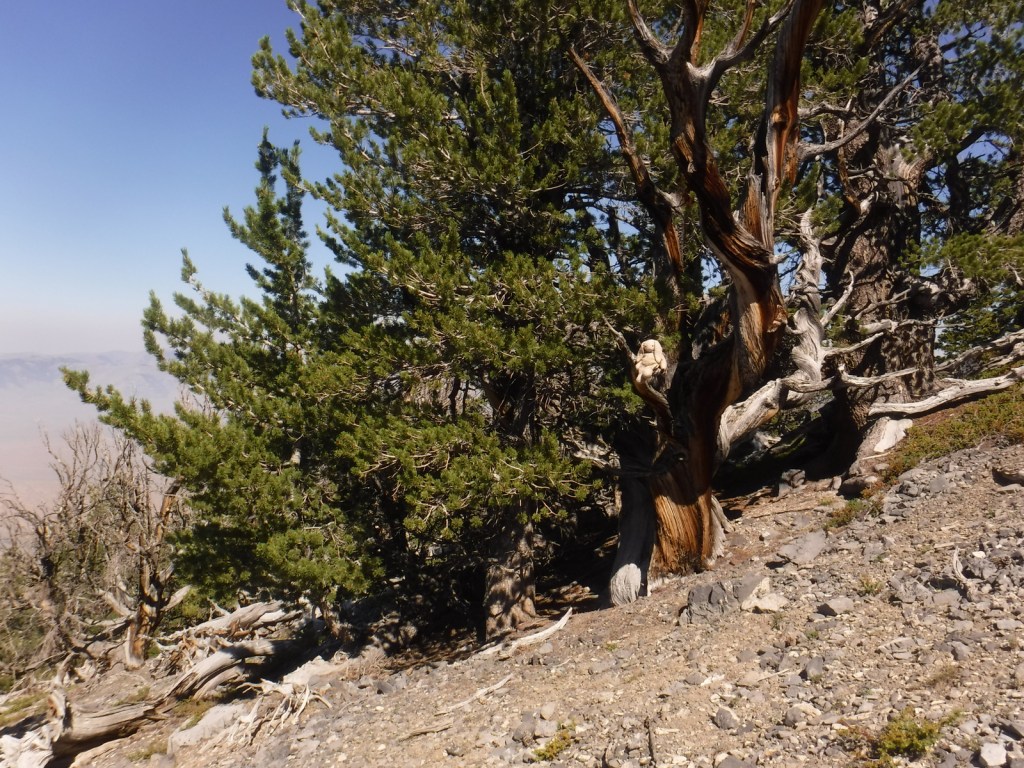
| Unassuming in size due to their subalpine habitat, Great Basin bristlecone pines are the world’s oldest single-stemmed tree reaching more than 5,000 years of age (see Inyo National Forest). Growing seasons are short and winters harsh at the high elevations where they grow, so their pine needles can persist on branches more than 30 years. |
| Pinus monophylla |
| singleleaf pinyon pine |
| With a range further west than two-needle pinyon pine, this small, drought tolerant tree is found throughout the Great Basin, which is why it is the official state tree of Nevada. Its edible “pine nuts” are eaten by many birds and mammals, particularly packrats. |
| Pinus monticola |
| western white pine |
| The straight, self-pruning stems of this tree species made it a target of nineteenth-century loggers from the Pacific Coast to the Inland Empire. Its maximum size has been measured at 239 feet tall and 8.4 feet in diameter. |
| Pinus palustris |
| longleaf pine |
| Longleaf pine forests were heavily cut by European settlers to produce naval stores, so that they are now only found on 3% of their original acreage. The tree is recognizable by its needles that reach 18 inches in length and its pointy pine cones that grow up to a foot long. |
| Pinus ponderosa |
| ponderosa pine |
| Perhaps the most widespread conifer in western North America, ponderosa pine is found from the Black Hills of South Dakota west to the arid mountains of Mexico and north into Canada. Young trees have dark bark and are often referred to as “blackjack pine,” while older trees develop cinnamon-colored plates that lent them the name “yellowbelly pine.” |
| Pinus pungens |
| Table Mountain pine |
| Table Mountain pine grows on rocky outcroppings throughout the southern Appalachians often alongside pitch pine, rarely reaching more than 40 feet in height. |
| Pinus radiata |
| Monterey pine |
| Grown in plantations around the world, this fog belt species is rare in its native California where it grows alongside Monterey cypress. |
| Pinus resinosa |
| red pine |
| Sometimes given the misleading name Norway spruce, this North American native tree forms an eye-pleasing, oval crown. It grows in mixed forests, in soils sandier than those preferred by eastern white pine, but wetter than those dominated by jack pine. |
| Pinus rigida |
| pitch pine |
| Often found growing on poor soils, pitch pine has a range that takes it from Georgia north into Maine. Historically it was an important species for producing naval stores, though it rarely reaches more than 60 feet in height. |
| Pinus sabiniana |
| gray pine |
| A small tree of the dry California foothills known for its characteristic egg-shaped pine cones that remain attached to the tree for many years. |
| Pinus strobiformis |
| southwestern white pine |
| Considered by some a variety of limber pine (with which it can hybridize), this species is restricted to the high elevations of the southwest where it can reach 80 feet in height and three feet in diameter. |
| Pinus strobus |
| eastern white pine |
| Found throughout the northeast U.S., this tree’s straight, clear boles up to six feet in diameter were targeted by loggers for centuries. Since then, this fast-growing species has aggressively colonized abandoned farm fields. |
| Pinus taeda |
| loblolly pine |
| The most important timber tree in the southeast U.S., loblolly pine is a fast-growing tree that thrives in a variety of soil types making it ideal for planting. |
| Pinus virginiana |
| Virginia pine |
| Found throughout the Appalachians, this old field pioneer forms thickets of trees not usually more than 40 feet tall or a foot in diameter, tolerating dry sites where other conifers cannot grow. |
| Pseudotsuga macrocarpa |
| bigcone Douglas-fir |
| Found only in southern California, this drought- and fire-tolerant relative of the major timber tree Douglas-fir has larger cones (four to eight inches in length) with the same iconic trident bracts that stick out from beneath its cone scales. |
| Pseudotsuga menziesii |
| Douglas-fir |
| The most commercially important tree species in North America, Douglas-fir is not a true fir and has been given its own unique Genus. It is sometimes separated into two subspecies, one for the dry Rocky Mountain growth form and another for the wet Pacific Coast where it can reach more than 300 feet in height and ten feet in diameter. |
| Sequoia sempervirens |
| coast redwood |
| Coast redwoods only grow within 50 miles of the Pacific Ocean where they rely on fog to help water them throughout the long summer dry period. They are the tallest trees on the planet, with one named Hyperion measured over 379 feet and still growing within Redwood National Park. |
| Sequoiadendron giganteum |
| giant sequoia |
| The world’s twelve largest trees by volume are all giant sequoias, with the top being the General Sherman tree at 52,508 cubic feet and in second place the General Grant tree at more than 40 feet in diameter. This fire-adapted species can have bark up to 31 inches thick. Giant sequoia trees are only found in 75 groves on the western slopes of California’s Sierra Nevada. |
| Taxodium distichum |
| baldcypress |
| Baldcypress is one of the few deciduous conifer trees in North America and is found along river bottoms, coastal marshes, and lake margins. Capable of growing buttressed trunks up to 17 feet in diameter, its decay-resistant wood was targeted by loggers. They are famous for their “knees” that rise from their roots up to seven feet high, possibly helping submerged roots breathe. |
| Taxus brevifolia |
| Pacific yew |
| Rarely reaching more than 50 feet in height, this shade tolerant shrub can be found from sea level up to 8,000 feet in elevation. Its bark was the original source of taxol, a cancer drug that is now synthetically produced. |
| Thuja occidentalis |
| northern white-cedar |
| This popular ornamental tree is native from the Great Lakes region east to Maine where it grows in swamps and limestone uplands. It is also called eastern arborvitae, which literally translates as “tree-of-life” because tea made from its foliage and bark prevents scurvy. |
| Thuja plicata |
| western redcedar |
| More well-known as a coastal species used by indigenous people to build canoes and totem poles, western redcedar is also found inland up to 6,600 feet in elevation. An important commercial tree for shingle manufacturing, it can reach 21 feet in diameter and more than 270 feet in height. |
| Torreya californica |
| California nutmeg |
| Not a true nutmeg, but a rare conifer endemic to the western slopes of the Sierra Nevada and central coast of California. Its long, sharp needles and is a sporadic ornamental planting. |
| Tsuga canadensis |
| eastern hemlock |
| Shade tolerant eastern hemlocks inhabit cool, moist coves in the southern Appalachians where they can survive more than 500 years and reach seven feet in diameter. Their population has been severely diminished by an outbreak of hemlock wooly adelgids in this region. |
| Tsuga heterophylla |
| western hemlock |
| This shade tolerant tree is one of the most commercially important species in the Pacific Northwest, with a straight, clear stem capable of growing more than four feet in diameter. |
| Tsuga mertensiana |
| mountain hemlock |
| This shade tolerant tree is well distributed from Alaska through the Rocky Mountains, found from sea-level to 11,000 feet in elevation. In subalpine areas it can often grow as a sprawling shrub, while in temperate rainforests it can reach 197 feet in height and seven feet in diameter. |































 Raven About The Parks